Table of Contents
My Brother And My Lord
This song is sung from the heart of Mary Magdalene, looking back on everything Jesus did for her.
Watch the lyric video on our YouTube channel:
My Brother And My Lord

Verse 1
The only father I remember,
Used my beauty to make him rich.
Then betrayed me to hide his guilt!
I fully expected to die,
Yet He forgave and set me free!

Chorus
You’re My one and only First Love,
The only Man who never used me!
The only One who saw my value,
And always stood on my behalf.
You are my Brother and My Lord.

Verse 2
You gave me a real family,
My own Martha and Lazarus!
You never hid the truth from me,
Even that You were going to die,
You always loved and trusted me.

Chorus
You’re My one and only First Love,
The only Man who never used me!
The only One who saw my value,
And always stood on my behalf.
You are my Brother and My Lord.

Verse 3
You knew I needed Lazarus,
And brought him back to me again!
You always gave Yourself to me,
You kept forgiving all my sins,
And trusted me to keep Your Law.

Chorus
You’re My one and only First Love,
The only Man who never used me!
The only One who saw my value,
And always stood on my behalf.
You are my Brother and My Lord.

Verse 4
My whole world died along with You,
My heart was crushed beyond repair!
You and Your Dad waited for me,
My sorrow evaporated,
When You simply called me Mary.

Chorus
You’re My one and only First Love,
The only Man who never used me!
The only One who saw my value,
And always stood on my behalf.
You are my Brother and My Lord.

Verse 5
You sent me to say you’re alive,
On that awesome Sunday morning!
You trusted me with the Spirit
On that first day of Pentecost.
And sent me out to do your will!

Chorus
You’re My one and only First Love,
The only Man who never used me!
The only One who saw my value,
And always stood on my behalf.
You are my Brother and My Lord.

Ending
The only One who saw my value,
And always stood on my behalf.
You are my Brother and My Lord.
Mary Magdalene had every reason never to trust a man again. The men who should have protected her used her. The men who judged her had helped make her what she was. Then she met the One Man who never used her, never shamed her, and never once let anyone else do it either. This song is her answer to Him.
I wrote it in her voice, the way I imagine she might have sung it years later, looking back over everything He did for her. Let us go through it verse by verse and set each line beside what the Word of God and the Spirit of Prophecy actually say.
Who Is Singing This Song?
The Gospels mention several women named Mary, and many readers keep Mary Magdalene and Mary of Bethany, the sister of Martha and Lazarus, apart as two different women. Sister White treats them as one woman, and she gathers her whole story into a single paragraph:
It was Mary who sat at His feet and learned of Him. It was Mary who poured upon His head the precious anointing oil, and bathed His feet with her tears. Mary stood beside the cross, and followed Him to the sepulcher. Mary was first at the tomb after His resurrection. It was Mary who first proclaimed a risen Saviour. (The Desire of Ages, p. 568)
That is the woman singing here. The details of her early life in the first verse come from my own study of the Bible and of The Desire of Ages, and I want to be honest about where Scripture ends and my reflection begins. Here is how I read her story: she lost her parents young; Simon took her in, and instead of protecting her he led her into sin; and when it suited him, he and the other religious leaders used her to set a trap for Jesus. Not every step of that is spelled out in so many words. But the pieces it is built from are there, and you can weigh them yourself.
Verse 1 — The Father Who Used Her
Verse 1
The only father I remember,
Used my beauty to make him rich.
Then betrayed me to hide his guilt!
I fully expected to die,
Yet He forgave and set me free!
At Simon’s feast, when Simon looked down on Mary, Jesus answered him with a parable about two debtors. Sister White explains why that parable cut so deep:
Simon had led into sin the woman he now despised. She had been deeply wronged by him. (The Desire of Ages, p. 566)
Now put that beside the woman dragged into the temple in John 8. The men who brought her there were not defending God’s law at all:
These would-be guardians of justice had themselves led their victim into sin, that they might lay a snare for Jesus. (The Desire of Ages, p. 461)
I believe the woman in John 8 and the woman at Simon’s table are the same Mary, and that is the betrayal “to hide his guilt” in this verse. Whether or not you read it that way, look at what that woman felt when Jesus said, “He that is without sin among you, let him first cast a stone”:
The woman had stood before Jesus, cowering with fear. His words, “He that is without sin among you, let him first cast a stone,” had come to her as a death sentence. She dared not lift her eyes to the Saviour’s face, but silently awaited her doom. (The Desire of Ages, p. 462)
“I fully expected to die.” Instead, every accuser walked away, and she heard this:
When Jesus had lifted up himself, and saw none but the woman, he said unto her, Woman, where are those thine accusers? hath no man condemned thee? She said, No man, Lord. And Jesus said unto her, Neither do I condemn thee: go, and sin no more. (John 8:10, 11 KJV)
This was to her the beginning of a new life, a life of purity and peace, devoted to the service of God. (The Desire of Ages, p. 462)
And notice who else Jesus showed mercy to. Simon himself, the man who had ruined her, was a leper whom Jesus healed: “By curing Simon of leprosy, Christ had saved him from a living death” (The Desire of Ages, p. 566). I have often wondered whether the guilt of what Simon had done to Mary is what brought that leprosy on him. Scripture does not say so, so take it only as a “perhaps.” But either way, Jesus healed the abuser as well as the abused. That is the kind of Lord she is singing about.
Verse 2 — A Real Family
Verse 2
You gave me a real family,
My own Martha and Lazarus!
You never hid the truth from me,
Even that You were going to die,
You always loved and trusted me.
Whether Martha and Lazarus were Mary’s sister and brother by birth or became her family later does not matter much. What matters is the love among the three of them, and the love Jesus had for all three:
Now Jesus loved Martha, and her sister, and Lazarus. (John 11:5 KJV)
A woman who had been used by the one man who should have been her father finally had a home where she was safe. And in that home Jesus told her the truth, even the hardest truth of all:
She had heard Jesus speak of His approaching death, and in her deep love and sorrow she had longed to show Him honor. At great personal sacrifice she had purchased an alabaster box of “ointment of spikenard, very costly,” with which to anoint His body. (The Desire of Ages, p. 558)
Compare that with the twelve disciples. Jesus told them plainly, more than once, that He would be killed in Jerusalem. Here is how much of it they took in:
And they understood none of these things: and this saying was hid from them, neither knew they the things which were spoken. (Luke 18:34 KJV)
The disciples were waiting for a throne. Mary was preparing for a burial. I believe she was probably the only one who took Him at His word and believed He was going to die, just as He said. That is why she bought the ointment before anyone else understood what was coming.
She did not understand everything. But she let the Holy Spirit guide what she did, and that was enough:
Mary knew not the full significance of her deed of love. She could not answer her accusers. She could not explain why she had chosen that occasion for anointing Jesus. The Holy Spirit had planned for her, and she had obeyed His promptings. (The Desire of Ages, p. 560)
That is what “You always loved and trusted me” means. He trusted her with the news of His death, and He trusted the Holy Spirit to lead her heart even where her understanding could not yet follow.
Verse 3 — The First Tomb
Verse 3
You knew I needed Lazarus,
And brought him back to me again!
You always gave Yourself to me,
You kept forgiving all my sins,
And trusted me to keep Your Law.
Two tombs built Mary’s faith. The first was her brother’s. When Lazarus died, Jesus did not stand at a distance. He wept with her (John 11:35), and then He did what only God can do:
And when he thus had spoken, he cried with a loud voice, Lazarus, come forth. (John 11:43 KJV)
But the tombs only built her faith. What won her heart was the way He treated her, again and again. Her freedom did not come all at once:
Seven times she had heard His rebuke of the demons that controlled her heart and mind. She had heard His strong cries to the Father in her behalf. She knew how offensive is sin to His unsullied purity, and in His strength she had overcome. (The Desire of Ages, p. 568)
Seven times. “You kept forgiving all my sins.” If you have ever fallen back into the same sin you thought you had left behind, take heart from Mary. He did not give up on her after the first time, or the sixth. And He did not just forgive her. He trusted her to keep His law, “in His strength,” and she did. “Go, and sin no more” was not a threat. It was a promise of what He would do in her.
Wherefore I say unto thee, Her sins, which are many, are forgiven; for she loved much: but to whom little is forgiven, the same loveth little. (Luke 7:47 KJV)
Verse 4 — The Second Tomb
Verse 4
My whole world died along with You,
My heart was crushed beyond repair!
You and Your Dad waited for me,
My sorrow evaporated,
When You simply called me Mary.
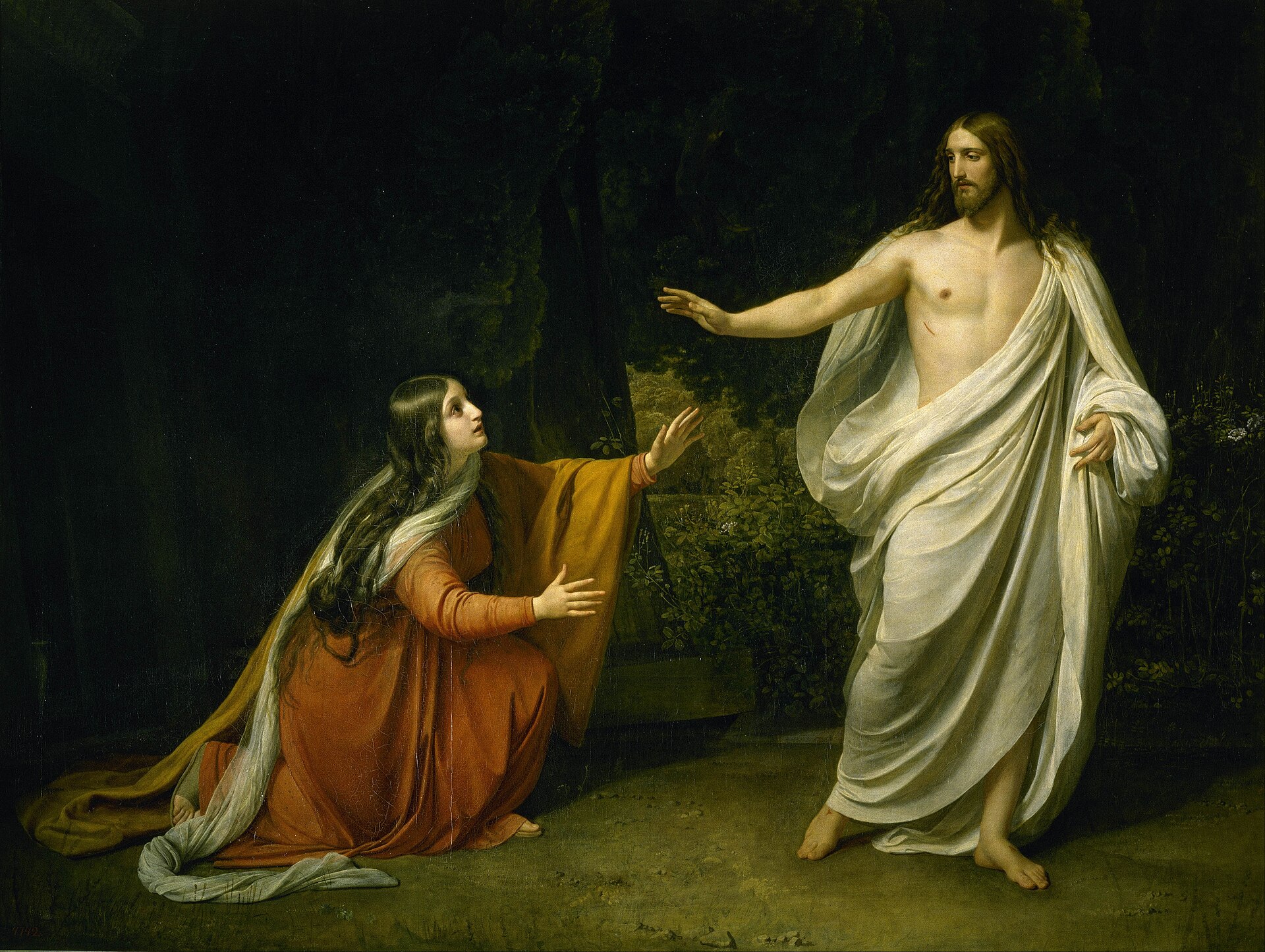
Mary stood by the cross and followed His body to the grave. On Sunday morning she found that grave empty, and she thought someone had stolen Him. Look at where her mind went, back to the first tomb:
There was a grave that Christ’s own voice had made vacant, the grave where Lazarus had lain. Might she not there find a burial place for her Lord? (The Desire of Ages, p. 790)
The two tombs meet in that one moment. And then, with one word, everything changed:
Jesus saith unto her, Mary. She turned herself, and saith unto him, Rabboni; which is to say, Master. (John 20:16 KJV)
Now look at what Jesus said next, and why:
Jesus saith unto her, Touch me not; for I am not yet ascended to my Father: but go to my brethren, and say unto them, I ascend unto my Father, and your Father; and to my God, and your God. (John 20:17 KJV)
Jesus refused to receive the homage of His people until He had the assurance that His sacrifice was accepted by the Father. (The Desire of Ages, p. 790)
Think about the order of that morning. Jesus had not yet gone to His Father to hear that His sacrifice was accepted. The whole universe was waiting for that moment. And yet He stopped in the garden first, for one grieving woman, so that she would not have to cry another hour. That is the line “You and Your Dad waited for me.” The Father and the Son both held the greatest celebration in the history of heaven until Mary had been comforted.
Verse 5 — Sent Out
Verse 5
You sent me to say you’re alive,
On that awesome Sunday morning!
You trusted me with the Spirit
On that first day of Pentecost.
And sent me out to do your will!
The woman who had once been dragged into the temple to be stoned was the first person Jesus sent to tell the world He was alive:
Mary Magdalene came and told the disciples that she had seen the Lord, and that he had spoken these things unto her. (John 20:18 KJV)
Then, while the disciples waited for the promised Spirit, the women were in that upper room with them:
These all continued with one accord in prayer and supplication, with the women, and Mary the mother of Jesus, and with his brethren. (Acts 1:14 KJV)
Scripture does not list every woman by name, but it is hard to imagine Mary anywhere else. And when the day of Pentecost came, “they were all filled with the Holy Ghost” (Acts 2:4). The Spirit who had guided her hands at Simon’s table now filled her, and sent her out to do His will.
The Chorus — Her First Love
Chorus
You’re My one and only First Love,
The only Man who never used me!
The only One who saw my value,
And always stood on my behalf.
You are my Brother and My Lord.
“First Love” comes from Jesus’ message to the church in Ephesus: “Nevertheless I have somewhat against thee, because thou hast left thy first love” (Revelation 2:4). Mary never left hers.
“The only One who saw my value.” Everyone else saw what she had been. Jesus saw what she could become:
Mary had been looked upon as a great sinner, but Christ knew the circumstances that had shaped her life. He might have extinguished every spark of hope in her soul, but He did not. It was He who had lifted her from despair and ruin. (The Desire of Ages, p. 568)
“And always stood on my behalf.” Go back through the verses and count the times. When the leaders wanted her stoned, He stood up for her. When Simon despised her, He told the parable that exposed Simon instead. When Martha complained that Mary sat at His feet, He said Mary had “chosen that good part” (Luke 10:42). When Judas called her gift a waste, He said, “Let her alone” (John 12:7). And when she wept alone at the empty tomb, He came to her before He went to His Father. Every time others turned on her, He took her side.
And why “Brother”? Because that is what He calls everyone who follows Him:
For whosoever shall do the will of God, the same is my brother, and my sister, and mother. (Mark 3:35 KJV)
In the garden He called His disciples “my brethren,” and His Father “your Father.” He is our Brother because He made His Father ours. He is our Lord because He bought us with His own blood. Mary knew Him as both.
Your Brother And Your Lord
Maybe you have been used too. Maybe the people who should have protected you are the ones who hurt you, and maybe the people who judge you the loudest are the ones who helped push you down. Mary’s story is for you. The same Jesus who stood between her and the stones will stand between you and every accuser, including the one Scripture calls “the accuser of our brethren” (Revelation 12:10). He sees your value. He will never use you. And He is waiting to call you by your name.
This song has a companion, My Brother And My King, sung by the bride of Christ, His church. Mary’s story is one woman’s story. The bride’s story is the story of all of us.