Paul now does something he clearly finds distasteful — he “boasts,” matching the false apostles at Corinth on their own terms, point for point, purely to expose how empty their terms actually are. Underneath the uncomfortable rhetoric of chapter 11 sits a real pastor’s anguish: a church he personally won for Christ is being pulled toward “another Jesus” by smooth-talking rivals, and the only way to stop it is to let them see exactly what those rivals’ credentials are actually worth.
A study in 2 Corinthians 11 · Arthur Baldwin · StandUp4Jesus.Org · 17 min read
Espoused As A Chaste Virgin
“Would to God ye could bear with me a little in my folly: and indeed bear with me. For I am jealous over you with godly jealousy: for I have espoused you to one husband, that I may present you as a chaste virgin to Christ.”
2 Corinthians 11:1-2
“The Lord has joined His people to Himself by a solemn covenant, He promising to be their God, and they pledging themselves to be His and His alone. … And Paul employs the same figure in the New Testament when he says: ‘I have espoused you to one husband, that I may present you as a chaste virgin to Christ.’”
Ellen G. White · The Great Controversy, p. 381
Paul’s jealousy here is not petty possessiveness but the jealousy of a marriage covenant — the same covenant this study’s own source traces all the way back to Hosea and Jeremiah’s own language for Israel’s relationship to God, and forward into Revelation’s own picture of a pure church versus an apostate one. Paul personally arranged this marriage, so to speak, and he is watching a third party try to seduce his own bride away from her husband.
“But I fear, lest by any means, as the serpent beguiled Eve through his subtilty, so your minds should be corrupted from the simplicity that is in Christ. For if he that cometh preacheth another Jesus, whom we have not preached, or if ye receive another spirit, which ye have not received, or another gospel, which ye have not accepted, ye might well bear with him.”
2 Corinthians 11:3-4
Paul reaches all the way back to Eden for his comparison — the serpent’s method was never open assault but subtle beguiling, and he sees the identical pattern in whatever rival teachers are currently working on Corinth with “another Jesus” and “another gospel.”
Not A Whit Behind The Very Chiefest Apostles
“For I suppose I was not a whit behind the very chiefest apostles. But though I be rude in speech, yet not in knowledge; but we have been throughly made manifest among you in all things.”
2 Corinthians 11:5-6
“It was not to exalt self, but to magnify the grace of God, that Paul thus presented to those who were denying his apostleship, proof that he was ‘not a whit behind the very chiefest apostles.’ … Those who sought to belittle his calling and his work were fighting against Christ, whose grace and power were manifested through Paul.”
Ellen G. White · The Acts of the Apostles, p. 388
This study’s own source draws the crucial distinction Paul himself is careful to make throughout this chapter — the boasting is uncomfortable precisely because it looks like self-promotion, but its actual target is the grace of God being denied when Paul’s own calling is denied.
“Have I committed an offence in abasing myself that ye might be exalted, because I have preached to you the gospel of God freely? I robbed other churches, taking wages of them, to do you service. And when I was present with you, and wanted, I was chargeable to no man…and in all things I have kept myself from being burdensome unto you, and so will I keep myself.”
2 Corinthians 11:7-9
“Paul tells why he had followed this course in Corinth. It was that he might give no cause for reproach to ‘them which desire occasion.’”
Ellen G. White · The Acts of the Apostles, p. 350
Paul’s refusal of Corinthian financial support, explained more fully back in chapter 8’s discussion of the collection, now shows its real strategic purpose — denying his critics any legitimate charge of financial self-interest, a charge his rivals apparently could not make about themselves.
“As the truth of Christ is in me, no man shall stop me of this boasting in the regions of Achaia. Wherefore? because I love you not? God knoweth. But what I do, that I will do, that I may cut off occasion from them which desire occasion; that wherein they glory, they may be found even as we.” — 2 Corinthians 11:10-12
Transformed Into An Angel Of Light
“For such are false apostles, deceitful workers, transforming themselves into the apostles of Christ. And no marvel; for Satan himself is transformed into an angel of light. Therefore it is no great thing if his ministers also be transformed as the ministers of righteousness; whose end shall be according to their works.”
2 Corinthians 11:13-15
“Satan is preparing his deceptions, that in his last campaign against the people of God they may not understand that it is he. ‘And no marvel; for Satan himself is transformed into an angel of light.’ … He is too cunning to come openly, boldly, with his temptations; for then the drowsy energies of the Christian would arouse, and he would rely upon the strong and mighty Deliverer. But he comes in unperceived, and works in disguise through the children of disobedience who profess godliness.”
Ellen G. White · Testimonies for the Church, vol. 1, p. 341
Paul’s diagnosis of the false apostles at Corinth becomes, in this study’s own source, a template for recognizing deception in any age — the danger was never crude, obvious counterfeits, but polished, plausible ones dressed convincingly as light. Corinth’s rival teachers were the local, first-century instance of a pattern this passage warns will recur “in his last campaign against the people of God.”
“I say again, Let no man think me a fool; if otherwise, yet as a fool receive me, that I may boast myself a little. That which I speak, I speak it not after the Lord, but as it were foolishly, in this confidence of boasting. Seeing that many glory after the flesh, I will glory also. For ye suffer fools gladly, seeing ye yourselves are wise. For ye suffer, if a man bring you into bondage, if a man devour you, if a man take of you, if a man exalt himself, if a man smite you on the face.” — 2 Corinthians 11:16-20
Paul’s list of what the Corinthians have been quietly tolerating from these rival teachers — being enslaved, exploited, taken advantage of, condescended to, even physically struck — makes an ironic point sharpen with every clause: the church that prides itself on wisdom has been remarkably credulous toward men doing exactly what false apostles do.
In Perils Often
“I speak as concerning reproach, as though we had been weak. Howbeit whereinsoever any is bold, (I speak foolishly,) I am bold also. Are they Hebrews? so am I. Are they Israelites? so am I. Are they the seed of Abraham? so am I. Are they ministers of Christ? (I speak as a fool) I am more; in labours more abundant, in stripes above measure, in prisons more frequent, in deaths oft.”
2 Corinthians 11:21-23
Paul matches his rivals credential for credential on their own preferred terms — Hebrew ancestry, Israelite standing, Abrahamic descent — before the comparison suddenly inverts. Where they measured greatness by status, Paul measures it by suffering.
“Of the Jews five times received I forty stripes save one. Thrice was I beaten with rods, once was I stoned, thrice I suffered shipwreck, a night and a day I have been in the deep; In journeyings often, in perils of waters, in perils of robbers, in perils by mine own countrymen, in perils by the heathen, in perils in the city, in perils in the wilderness, in perils in the sea, in perils among false brethren; In weariness and painfulness, in watchings often, in hunger and thirst, in fastings often, in cold and nakedness.”
2 Corinthians 11:24-27
“Thus passed his life, as described in his own words, ‘in journeyings often, in perils of waters, in perils of robbers, in perils by mine own countrymen, in perils by the heathen, in perils in the city, in perils in the wilderness, in perils in the sea, in perils among false brethren; in weariness and painfulness, in watchings often, in hunger and thirst, in fastings often, in cold and nakedness.’”
Ellen G. White · Education, p. 67
This study’s own source places this catalogue at the close of a survey of Paul’s entire public life — Athens before the philosophers, Festus and Agrippa in the governor’s court, and finally this raw list of what it actually cost, in his own summarizing words, to carry the gospel everywhere he carried it.
“Beside those things that are without, that which cometh upon me daily, the care of all the churches. Who is weak, and I am not weak? who is offended, and I burn not? If I must needs glory, I will glory of the things which concern mine infirmities.”
2 Corinthians 11:28-30
The physical dangers, extensive as the list already is, are not even what weighs on Paul most heavily — “the care of all the churches,” a daily, ongoing burden of pastoral concern for congregations he cannot always be present with, tops even shipwreck and beatings on his own accounting.
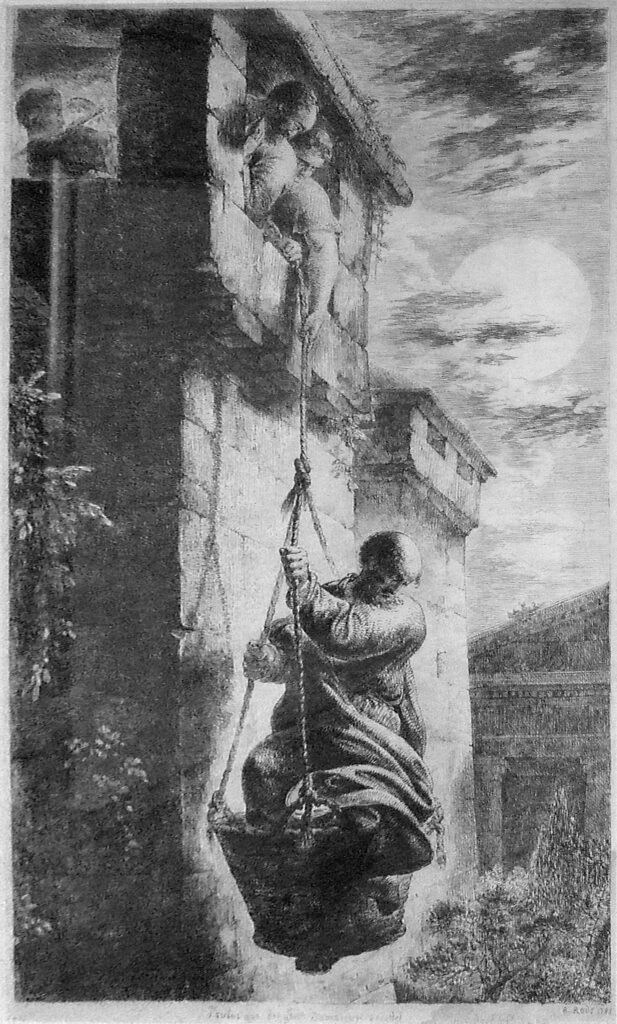
“The God and Father of our Lord Jesus Christ, which is blessed for evermore, knoweth that I lie not. In Damascus the governor under Aretas the king kept the city of the Damascenes with a garrison, desirous to apprehend me: And through a window in a basket was I let down by the wall, and escaped his hands.”
2 Corinthians 11:31-33
The chapter’s closing image is deliberately undignified — not a triumphant escape but a man smuggled out in a basket like cargo, the very opposite of the polished credentials his rivals were parading. Paul chooses to end his entire catalogue of apostolic proof on precisely this note: the last, least impressive fact he could have offered, and, in his own accounting, exactly the kind of thing worth boasting in.