The Gospel already had its proper ending. “These are written, that ye might believe” closed chapter 20 the way a book is supposed to close. And yet John adds one more chapter anyway — a quiet morning of fishing, a breakfast of bread and fish on a beach, and a conversation between the risen Christ and the disciple who denied Him three times. It is the least dramatic chapter in the whole book, and it may be the most personal.
A study in John 21 · Arthur Baldwin · StandUp4Jesus.Org · 24 min read
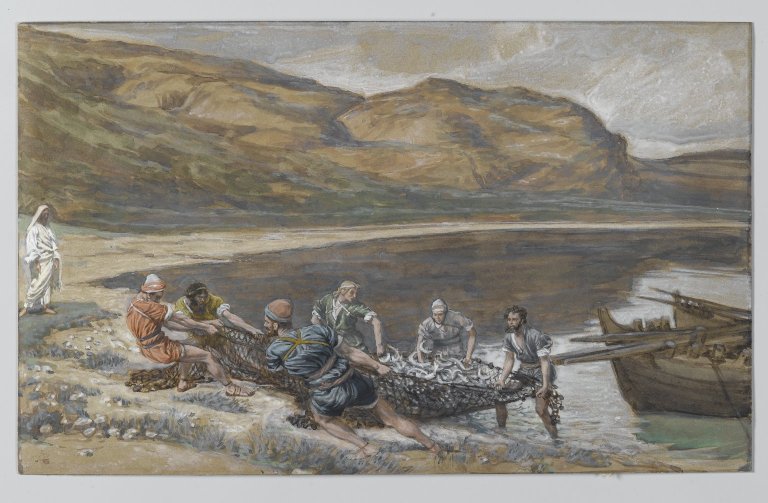
It Is The Lord
“After these things Jesus shewed himself again to the disciples at the sea of Tiberias; and on this wise shewed he himself. There were together Simon Peter, and Thomas called Didymus, and Nathanael of Cana in Galilee, and the sons of Zebedee, and two other of his disciples.”
John 21:1-2
“Jesus had appointed to meet His disciples in Galilee; and soon after the Passover week was ended, they bent their steps thither. … Seven of the disciples were in company. They were clad in the humble garb of fishermen; they were poor in worldly goods, but rich in the knowledge and practice of the truth, which in the sight of Heaven gave them the highest rank as teachers.”
Ellen G. White · The Desire of Ages, p. 809
Seven men return to the water they know best, in the region where most of this Gospel’s own miracles happened, surrounded on every side by places that must have ached with memory — the beach where thousands were fed, the sea Christ once walked on, Capernaum just up the shore.
“Simon Peter saith unto them, I go a fishing. They say unto him, We also go with thee. They went forth, and entered into a ship immediately; and that night they caught nothing.”
John 21:3
“So they went out in their boat, but they caught nothing. All night they toiled, without success. Through the weary hours they talked of their absent Lord, and recalled the wonderful events they had witnessed in His ministry beside the sea. They questioned as to their own future, and grew sad at the prospect before them.”
Ellen G. White · The Desire of Ages, p. 810
An empty net after a full night’s work is a fitting picture of where seven of Christ’s closest followers actually stand right now — capable men, doing the only trade they know, with nothing to show for the effort and no clear sense of what comes next.
“But when the morning was now come, Jesus stood on the shore: but the disciples knew not that it was Jesus. Then Jesus saith unto them, Children, have ye any meat? They answered him, No. And he said unto them, Cast the net on the right side of the ship, and ye shall find. They cast therefore, and now they were not able to draw it for the multitude of fishes.”
John 21:4-6
“All the while a lone watcher upon the shore followed them with His eye, while He Himself was unseen. At length the morning dawned. The boat was but a little way from the shore, and the disciples saw a stranger standing upon the beach, who accosted them with the question, ‘Children, have ye any meat?’”
Ellen G. White · The Desire of Ages, p. 810
The very same instruction — a net cast at His word, on a lake they knew better than He supposedly did — is what once launched their whole discipleship years earlier, when Jesus first called them away from these same boats to become fishers of men.
“Vividly they recalled the scene beside the sea when Jesus had bidden them follow Him. They remembered how, at His command, they had launched out into the deep, and had let down their net, and the catch had been so abundant as to fill the net, even to breaking. Then Jesus had called them to leave their fishing boats, and had promised to make them fishers of men.”
Ellen G. White · The Desire of Ages, p. 810
It is the same miracle, deliberately repeated, and it is not hard to see why: whatever these seven men do next with their lives, the risen Christ wants them to remember exactly how this all began.
“Therefore that disciple whom Jesus loved saith unto Peter, It is the Lord. Now when Simon Peter heard that it was the Lord, he girt his fisher’s coat unto him, (for he was naked,) and did cast himself into the sea.”
John 21:7
“John recognized the stranger, and exclaimed to Peter, ‘It is the Lord.’ Peter was so elated and so glad that in his eagerness he cast himself into the water and was soon standing by the side of his Master.”
Ellen G. White · The Desire of Ages, p. 810
It is the same pairing this Gospel keeps returning to at every major turn — John the one who sees and understands first, Peter the one who acts first, without waiting for the boat to finish the short swim to shore.
“And the other disciples came in a little ship; (for they were not far from land, but as it were two hundred cubits,) dragging the net with fishes. As soon then as they were come to land, they saw a fire of coals there, and fish laid thereon, and bread.”
John 21:8-9
A fire of coals appears only twice in this Gospel. The first time, Peter stood warming himself at one in a high priest’s courtyard and denied his Lord three times. This second fire, built by the same Lord’s own hands, is about to become the place where all three denials are quietly, deliberately undone.
“Jesus saith unto them, Bring of the fish which ye have now caught. Simon Peter went up, and drew the net to land full of great fishes, an hundred and fifty and three: and for all there were so many, yet was not the net broken.”
John 21:10-11
John, decades later, still remembers the exact count — one hundred fifty-three, an oddly specific number for a Gospel not otherwise given to counting things, the kind of detail only someone who was actually there helping haul the net in would bother to preserve.
“Jesus saith unto them, Come and dine. And none of the disciples durst ask him, Who art thou? knowing that it was the Lord. Jesus then cometh, and taketh bread, and giveth them, and fish likewise. This is now the third time that Jesus shewed himself to his disciples, after that he was risen from the dead.”
John 21:12-14
“He broke the food, and divided it among them, and was known and acknowledged by all the seven. The miracle of feeding the five thousand on the mountainside was now brought to their minds; but a mysterious awe was upon them, and in silence they gazed upon the risen Saviour.”
Ellen G. White · The Desire of Ages, p. 810
Awe and breakfast sit side by side in this scene without any apparent tension — the risen Lord of the universe cooking fish over coals for seven tired, silent men who already know exactly who He is and still cannot find a word to say to Him.
Feed My Sheep
“Peter’s denial of his Lord had been in shameful contrast to his former professions of loyalty. He had dishonored Christ, and had incurred the distrust of his brethren. … Before being called to take up again his apostolic work, he must before them all give evidence of his repentance.”
Ellen G. White · The Desire of Ages, p. 811
Three public denials, back in chapter 18, called for something more than a private, silent forgiveness. What follows happens in front of the same six brothers who watched Peter’s courage fail him.
“So when they had dined, Jesus saith to Simon Peter, Simon, son of Jonas, lovest thou me more than these? He saith unto him, Yea, Lord; thou knowest that I love thee. He saith unto him, Feed my lambs.”
John 21:15
“Peter had once declared, ‘Though all men shall be offended because of Thee, yet will I never be offended.’ … But he now put a truer estimate upon himself. ‘Yea, Lord,’ he said, ‘Thou knowest that I love Thee.’ There is no vehement assurance that his love is greater than that of his brethren.”
Ellen G. White · The Desire of Ages, p. 811
Jesus calls him “Simon, son of Jonas” — his old name, from before he was ever called Peter, “the rock.” It is a gentle way of meeting him exactly where his failure left him, rather than where his old confidence once placed him.
“He saith to him again the second time, Simon, son of Jonas, lovest thou me? He saith unto him, Yea, Lord; thou knowest that I love thee. He saith unto him, Feed my sheep.”
John 21:16
“He saith unto him the third time, Simon, son of Jonas, lovest thou me? Peter was grieved because he said unto him the third time, Lovest thou me? And he said unto him, Lord, thou knowest all things; thou knowest that I love thee. Jesus saith unto him, Feed my sheep.”
John 21:17
“Three times Peter had openly denied his Lord, and three times Jesus drew from him the assurance of his love and loyalty, pressing home that pointed question, like a barbed arrow to his wounded heart. Before the assembled disciples Jesus revealed the depth of Peter’s repentance, and showed how thoroughly humbled was the once boasting disciple.”
Ellen G. White · The Desire of Ages, p. 812
Three questions for three denials is not a coincidence any reader of this Gospel is meant to miss. Each answer of love is met with a new commission, not a scolding — the past addressed by handing Peter a future, rather than by dwelling on the failure itself.
“The question that Christ had put to Peter was significant. He mentioned only one condition of discipleship and service. ‘Lovest thou Me?’ He said. This is the essential qualification. Though Peter might possess every other, yet without the love of Christ he could not be a faithful shepherd over the Lord’s flock.”
Ellen G. White · The Desire of Ages, p. 815
Every qualification a church might normally look for in a leader — boldness, eloquence, unwavering nerve — is quietly set aside here in favor of a single question that a man who has just failed spectacularly can still, humbly, answer yes to.
Follow Me
“Verily, verily, I say unto thee, When thou wast young, thou girdedst thyself, and walkedst whither thou wouldest: but when thou shalt be old, thou shalt stretch forth thy hands, and another shall gird thee, and carry thee whither thou wouldest not. This spake he, signifying by what death he should glorify God. And when he had spoken this, he saith unto him, Follow me.”
John 21:18-19
“Jesus thus made known to Peter the very manner of his death; He even foretold the stretching forth of his hands upon the cross. Again He bade His disciple, ‘Follow Me.’ Peter was not disheartened by the revelation. He felt willing to suffer any death for his Lord.”
Ellen G. White · The Desire of Ages, p. 815
Before His own death, Jesus had told Peter, “Whither I go, thou canst not follow Me now,” and Peter had answered with a boast he could not back up: “I will lay down my life for Thy sake.” He is now told, gently and precisely, that the day is coming when he finally will — and that it will end, like his Master’s own death, in outstretched hands on a Roman cross.
“Heretofore Peter had known Christ after the flesh, as many know Him now; but he was no more to be thus limited. He knew Him no more as he had known Him in his association with Him in humanity. He had loved Him as a man, as a heaven-sent teacher; he now loved Him as God.”
Ellen G. White · The Desire of Ages, p. 815
That single sentence — “he now loved Him as God” — is the whole arc of this Gospel compressed into one line about one man’s growth. Peter began by calling Jesus “Master.” By the last chapter of the book he wrote his own letters under, he is worshiping the same Man Thomas confessed as “my Lord and my God.”
What Is That To Thee?
“Then Peter, turning about, seeth the disciple whom Jesus loved following; which also leaned on his breast at supper, and said, Lord, which is he that betrayeth thee? Peter seeing him saith to Jesus, Lord, and what shall this man do?”
John 21:20-21
Just told the manner of his own coming death, Peter’s first instinct is to ask about someone else’s future instead of simply walking forward into his own.
“Jesus saith unto him, If I will that he tarry till I come, what is that to thee? follow thou me.”
John 21:22
“Peter should have considered that his Lord would reveal to him all that it was best for him to know. It is the duty of everyone to follow Christ, without undue anxiety as to the work assigned to others. … The future of both John and Peter was in the hands of their Lord. Obedience in following Him was the duty required of each.”
Ellen G. White · The Desire of Ages, p. 816
“Then went this saying abroad among the brethren, that that disciple should not die: yet Jesus said not unto him, He shall not die; but, If I will that he tarry till I come, what is that to thee?”
John 21:23
“In saying of John, ‘If I will that he tarry till I come,’ Jesus gave no assurance that this disciple should live until the Lord’s second coming. He merely asserted His own supreme power, and that even if He should will this to be so, it would in no way affect Peter’s work.”
Ellen G. White · The Desire of Ages, p. 816
John, writing these very words decades after the rumor had already spread and needed correcting, is careful to record exactly what Jesus did and did not say — a small, quiet act of precision from a man old enough by then to have watched a false report about his own life travel further than the actual truth of it.
“John lived to be very aged. He witnessed the destruction of Jerusalem, and the ruin of the stately temple. … To his latest days John closely followed his Lord. The burden of his testimony to the churches was, ‘Beloved, let us love one another;’ ‘he that dwelleth in love, dwelleth in God, and God in him.’”
Ellen G. White · The Desire of Ages, p. 816
Peter’s own later writings show the lesson of this beach conversation took root permanently. Years afterward, as an old man himself, he would write to the very elders he once feared he had lost the right to lead.
“‘The elders which are among you I exhort, who am also an elder, and a witness of the sufferings of Christ, and also a partaker of the glory that shall be revealed: Feed the flock of God which is among you, taking the oversight thereof, not by constraint, but willingly … neither as being lords over God’s heritage, but being ensamples to the flock.’”
Ellen G. White · The Desire of Ages, p. 817
The very word Christ used with him at that fire of coals — feed — is the word Peter reaches for, unprompted, when he in turn instructs the next generation of shepherds. The command given to one restored disciple on a Galilean beach outlived him, in his own handwriting, for the whole church to read.
His Testimony Is True
“This is the disciple which testifieth of these things, and wrote these things: and we know that his testimony is true. And there are also many other things which Jesus did, the which, if they should be written every one, I suppose that even the world itself could not contain the books that should be written. Amen.”
John 21:24-25
“We know that his testimony is true” is very likely not John’s own pen but the voice of the church that first received and preserved this Gospel, vouching for the old apostle who wrote it. It is a fitting note to end on for a book that opened by identifying Jesus as the eternal, uncreated Word by whom all things were made, and has spent twenty-one chapters proving that claim one witnessed sign at a time — water made wine, a man born blind given sight, a friend four days dead called back by name, a spear-wound and folded graveclothes and a doubting disciple’s confession, “My Lord and my God.” Every one of those signs was written down, John says plainly, for exactly one purpose: so that a reader who was never going to stand on that beach and eat that breakfast could still come to believe, and believing, have life through His name. The last word of the last chapter of the last Gospel is a fittingly small one for a book that began with the biggest claim any book has ever made: Amen. So be it.
