Every baby has to be weaned. It is never his idea. The milk is warm and sweet and it is all he has ever known, and for a few days he cries for it. But a wise mother does not wean her child to make him miserable. She weans him because something better is waiting: real food, strength, growing up. God does the same with His children. This study asks a simple question about one sweet, familiar night of the year: are you Halloweaned?
A Bible study · Arthur Baldwin · StandUp4Jesus.Org · 12 min read
What Weaning Means In The Bible
Before we ask “are you Halloweaned?” we need to know what weaning is. The Bible uses weaning as a picture of a soul growing up in God. David wrote:
“Surely I have behaved and quieted myself, as a child that is weaned of his mother: my soul is even as a weaned child.”
Psalm 131:2
And through Isaiah the Lord asks whom He can teach His deepest truths: “them that are weaned from the milk, and drawn from the breasts” (Isaiah 28:9). The milk is not wicked. It is simply for babies. A child who never lets go of it never grows up.
In Bible times weaning was not a sad day. It was a celebration:
“And the child grew, and was weaned: and Abraham made a great feast the same day that Isaac was weaned.”
Genesis 21:8
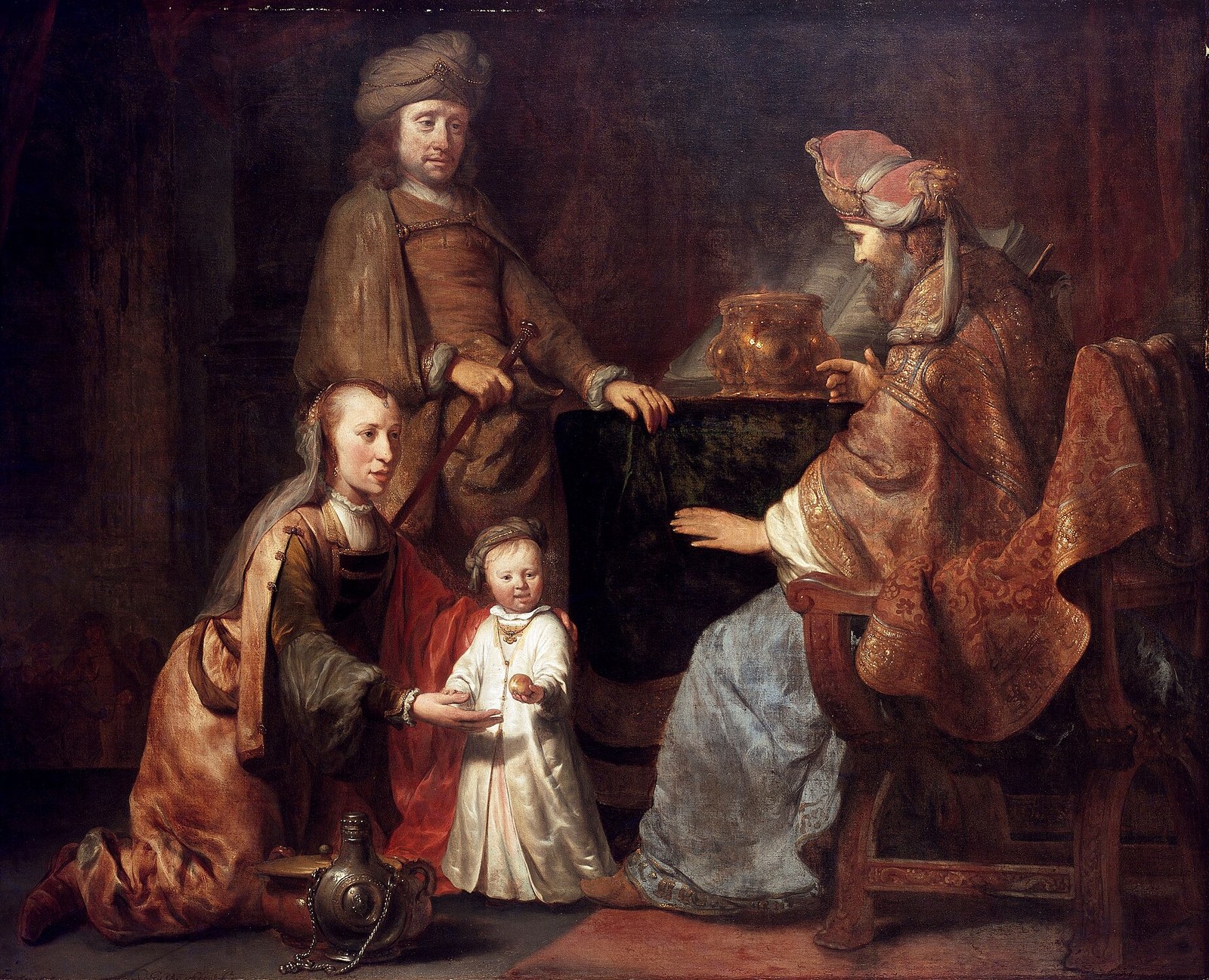
And for one mother it was the day she gave her child to God. Hannah had prayed for a son for years. When Samuel was born, she kept him at home only until he was weaned, and then she brought him to the house of the Lord at Shiloh:
“And when she had weaned him, she took him up with her, with three bullocks, and one ephah of flour, and a bottle of wine, and brought him unto the house of the LORD in Shiloh: and the child was young.”
1 Samuel 1:24
That is the scene in the painting above. The little boy is no longer on his mother’s lap. He is standing on his own feet, holding a piece of fruit, being given to the Lord. Weaning is how a child moves from being fed to being given.
Where Halloween Came From
Halloween is not just pumpkins and candy. Its roots go back more than a thousand years, along two lines that met:
- Samhain. The ancient Celts held a festival at the start of November, at the end of the harvest and the beginning of winter. They believed that on that night the boundary between the living and the dead grew thin, and the spirits of the dead came back to walk the earth. Fires were lit, offerings were set out, and people disguised themselves.
- All Hallows. The church of Rome set its feast of All Saints (“All Hallows”) on November 1, and later added All Souls’ Day on November 2, to pray for the souls of the dead. The evening before All Hallows became “All Hallows’ Eve,” and in time, Halloween.
- The customs. Going door to door for “soul cakes” in return for prayers for the dead, wearing masks and costumes, and carving faces into turnips (later pumpkins) with a light inside all grew up around those two ideas.
Look at what both lines share. The pagan night and the church’s feast both rest on one belief: that the dead are not really dead. Their spirits are somewhere, aware, and able to come near us, or to be helped by us. Halloween is, at its heart, a festival of the dead.
What The Bible Says About The Dead
God’s Word is plain about where the dead are:
“For the living know that they shall die: but the dead know not any thing, neither have they any more a reward; for the memory of them is forgotten.”
Ecclesiastes 9:5
The dead are asleep until the resurrection. They do not walk the earth on any night of the year (see The State Of The Dead). So if something comes claiming to be a spirit of the dead, it is not who it says it is. Ellen White traced the whole idea back to the garden:
“Modern spiritualism and the forms of ancient witchcraft and idol worship—all having communion with the dead as their vital principle—are founded upon that first lie by which Satan beguiled Eve in Eden: “Ye shall not surely die.””
Ellen G. White · Patriarchs and Prophets, p. 685
And the spirits that do come?
“The “familiar spirits” were not the spirits of the dead, but evil angels, the messengers of Satan.”
Ellen G. White · Patriarchs and Prophets, p. 685
That is why God closed this door so firmly. He listed the very practices Halloween grew out of, and called them abominations:
“There shall not be found among you any one that maketh his son or his daughter to pass through the fire, or that useth divination, or an observer of times, or an enchanter, or a witch, Or a charmer, or a consulter with familiar spirits, or a wizard, or a necromancer. For all that do these things are an abomination unto the LORD: and because of these abominations the LORD thy God doth drive them out from before thee.”
Deuteronomy 18:10-12
Instead, He points His people to Himself and to His Word:
“And when they shall say unto you, Seek unto them that have familiar spirits, and unto wizards that peep, and that mutter: should not a people seek unto their God? for the living to the dead? To the law and to the testimony: if they speak not according to this word, it is because there is no light in them.”
Isaiah 8:19-20
“But It’s Only Harmless Fun”
Most people who celebrate Halloween today are not trying to call up the dead. They want to see the children in their costumes and share some candy. It feels harmless. But the Bible does not ask only whether we mean harm. It asks whose works we are joining:
“And have no fellowship with the unfruitful works of darkness, but rather reprove them.”
Ephesians 5:11
Ellen White heard the same argument in her day, and answered it:
“It cannot be harmless for servants of the heavenly King to engage in the pleasures and amusements which Satan’s servants engage in, even though they often repeat that such amusements are harmless.”
Ellen G. White · Testimonies for the Church, vol. 1, p. 404
Israel did not fall at Baalpeor by first deciding to worship idols. They went to a party (Numbers 25:1-3). Ellen White drew the lesson for us:
“It was by associating with idolaters and joining in their festivities that the Hebrews were led to transgress God’s law and bring His judgments upon the nation. So now it is by leading the followers of Christ to associate with the ungodly and unite in their amusements that Satan is most successful in alluring them into sin.”
Ellen G. White · Patriarchs and Prophets, p. 458
A night that dresses children as ghosts, witches and skeletons, and fills the yard with tombstones, teaches them something about death, whether we mean it to or not. And what it teaches is the first lie, not the truth.
So let us call it what it is. A festival built on honoring the dead and on spirits that claim to be the dead is not neutral ground. The Bible says whose worship that really is:
“Ancient idolatry, which, as we have seen, comprises both worship of the dead and pretended communion with them, is declared by the Bible to have been demon worship.”
Ellen G. White · Patriarchs and Prophets, p. 685
Paul said the same: “the things which the Gentiles sacrifice, they sacrifice to devils, and not to God: and I would not that ye should have fellowship with devils” (1 Corinthians 10:20). Halloween, underneath the candy, is Satan’s night.
Why Christians Are Still Hooked
This year, October 31 fell on a Sabbath, and that bothered me a great deal. On the same day, God’s memorial of creation and life met the world’s festival of the dead. The parties and the costumes were planned for the very hours God calls “my holy day” (Isaiah 58:13), and as the sun went down on His Sabbath, the streets filled with skeletons and ghosts. That was the night this title came to me. (See The Bible Sabbath.)
If that is true, why do so many Christians, even Adventists who know about the state of the dead, still celebrate it? Not because they believe in ghosts. Because it is a social event. The whole street is out. The children’s friends are all going. The church fellowship may even host a party. Saying no means standing apart, and nobody likes to be the one dark house on the block, or the child who stays home.
That is the hook, and Satan knows it well. He rarely needs to persuade anyone that Halloween is good. He only needs them to feel that missing it would cost too much with their friends. God’s answer has not changed:
“Wherefore come out from among them, and be ye separate, saith the Lord, and touch not the unclean thing; and I will receive you,”
2 Corinthians 6:17
Coming out is not cutting yourself off from people. It is refusing to let the crowd decide whom you will honor. And the One who calls us out promises in the very next verse to be “a Father unto you” (2 Corinthians 6:18). We lose a party, and gain a family.
How I Was Halloweaned
Are you Halloweaned? For years, I was not.
I was raised the son of a Seventh-day Adventist pastor. My parents were singing evangelists, and later my dad served as an associate pastor. And yet my parents let me go trick-or-treating every year. My brother and I loved it, and I kept enjoying Halloween until I was in my twenties. I had known its history since I was twelve. Knowing it did not wean me.
What weaned me was meeting God for myself. In March of 1983 He gave me a personal Bible study on righteousness by faith, and I was rebaptized on March 27. That October I went looking for a Halloween party. A young man handed me a flyer about the history of Halloween on the way in, and as I sat and read it, God asked me a question: “Arthur, what do you really want?” The temptation to stay was strong. I left, and went home alone to an empty apartment. It was one of the hardest decisions I have ever made, and I have never regretted it. I tell the whole story in Halloween Or God?
Notice the order. The knowledge came first, and it was not enough. The weaning came when I had tasted something sweeter than the candy: a real friendship with God. I did not want to lose it.
Weaned To Something Better
Weaning is not just taking something away. A mother who only took the milk away and gave nothing in its place would starve her child. God never weans that way:
““Something better” is the watchword of education, the law of all true living. Whatever Christ asks us to renounce, He offers in its stead something better.”
Ellen G. White · Education, p. 296
Parents especially need to hear that. Children cannot be made to love a dark, empty evening while every other house on the street is lit up. Ellen White wrote:
“While sinful amusements are condemned, as they should be, let parents, teachers, and guardians of youth provide in their stead innocent pleasures which will not taint or corrupt the morals.”
Ellen G. White · The Adventist Home, p. 498
So plan the night before it comes. A few ideas:
- Make it a feast, as Abraham did on the day Isaac was weaned: a special family supper, the children’s favorite (healthy) treats, a harvest table that thanks God for the year’s blessings.
- Tell the true stories. Read about Hannah and Samuel, or about the angels who really do watch over us (Hebrews 1:14).
- Sing together, play games, or spend the evening with friends who love the Lord.
- Give, instead of get. Visit someone who is lonely, or bake for a neighbor on another day of the week, when it means something.
- Explain why, gently and simply, at their age. A child who understands that the dead are safely asleep in Jesus has nothing to fear from a skeleton costume, and no reason to want one.
Be kind to the neighbors who do celebrate. Most of them have never heard what the Bible says about the dead. Being weaned is not a reason to look down on anyone who has not been. It is a reason to be ready when they ask why.
The Feast Waiting For The Weaned
Are you Halloweaned, or still holding on to the milk? Look at what is waiting.
Ellen White said that the things we give up for Christ are “an exchange of the worthless and transitory for the precious and enduring” (Education, p. 296). One night of candy and costumes is the milk. Here is the feast:
“And he saith unto me, Write, Blessed are they which are called unto the marriage supper of the Lamb. And he saith unto me, These are the true sayings of God.”
Revelation 19:9
There the dead in Christ will not be wandering spirits. They will be raised, whole, with faces we know, and no one will ever need a mask again. Until that day, God has not left us alone with the dark. “Are they not all ministering spirits, sent forth to minister for them who shall be heirs of salvation?” (Hebrews 1:14). (See My Guardian Angel.)
So, Are You Halloweaned?
So, dear friend: are you Halloweaned? If you are not yet, do not wait until you have won an argument with yourself. Taste God first. “O taste and see that the LORD is good” (Psalm 34:8). Once you have, the old sweets lose their pull, and the weaning becomes a feast.
Read More
- Halloween Or God?: my own story
- The State Of The Dead
- Ye Cannot Drink The Cup Of The Lord And The Cup Of Devils
- My Guardian Angel
- Deceptions