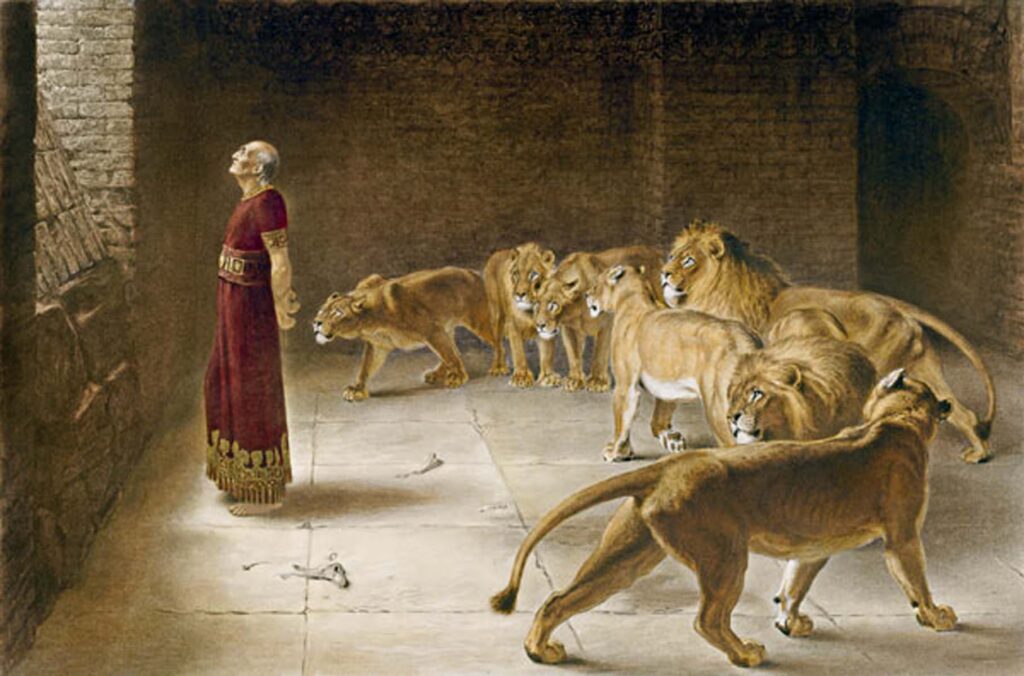
They investigated him thoroughly and found nothing. So they wrote a law that made his religion a crime — and got a king to sign it by appealing to his vanity. The politics are so familiar it hurts.
A study in Daniel · Arthur Baldwin · StandUp4Jesus.Org · 13 min read
Table of Contents
All Too Familiar Politics!
Based on Daniel Chapter 6
After the Medes and Persians took over Babylon, Daniel quickly rose to the highest position in the kingdom, except for the king. This really upset the other leaders and inspired their jealousy, and they became obsessed with finding a way to destroy Daniel! Eventually, they gave up trying to find “dirt” on Daniel and decided to get to him by appealing to the King’s sinful sense of pride! They convinced the King to pass a law that would cause everyone to worship the King as a god!
Daniel, of course, kept worshipping the only real God in his usual way! And, of course, these jealous rulers brought Daniel’s disobedience of the new law to the King’s attention! The King was “forced” to punish Daniel by putting him in the den of lions. God sent an angel to keep Daniel safe from the lions. And the King set Daniel free the following day!
But it didn’t end there! The King was so upset because those jealous leaders had purposely deceived him and put his most valued servant’s life at risk! The King decided to test the lions further by putting those deceptive leaders into the same lion’s den. This time, the lions instantly attacked and devoured all of them!
An Old Man, Sixty Years On
Sunday-school pictures put a young man among the lions. The arithmetic puts an old one.
Daniel was taken to Babylon as a youth in the first deportation. Babylon has now fallen — that was the night of Belshazzar’s feast — and the Medes and Persians are in charge. More than sixty years lie between chapter 1 and chapter 6. The man they threw to the lions was somewhere in his eighties.
That changes the scene. This is not a young man’s dramatic stand at the beginning of a career. It is the last recorded test of a life that had already refused the king’s food, interpreted the dream nobody could recover, watched a golden image go up, and read the writing on a wall. He had been faithful under four reigns and two empires, and at eighty-odd he was still the man they could not buy.
They Investigated Him And Found Nothing
Darius had set Daniel over the realm because an excellent spirit was in him (verse 3), and the men beneath him did what such men do. They opened an investigation.
“Then the presidents and princes sought to find occasion against Daniel concerning the kingdom; but they could find none occasion nor fault; forasmuch as he was faithful, neither was there any error or fault found in him.”
Daniel 6:4
Sit with that a moment, because it may be the highest compliment paid to any man in the Old Testament — and it comes from his enemies, by their failure.
These were colleagues with every motive to find something and every means to look. A man in charge of the revenues of an empire, examined by rivals who wanted him destroyed, and the audit came back clean. Not nothing serious. Nothing.
Then comes their conclusion, and it is one of the most chilling sentences in Scripture precisely because it is a compliment:
“We shall not find any occasion against this Daniel, except we find it against him concerning the law of his God.”
Daniel 6:5
The only thing they could use against him was his religion. They said so out loud, to each other, as a plan.
So They Legislated Against His Religion
Notice how carefully the trap is built. They do not accuse him of anything. They do not need to — the accusation would have to be false and would collapse. They change the law instead, so that what he does becomes the crime.
“…that whosoever shall ask a petition of any God or man for thirty days, save of thee, O king, he shall be cast into the den of lions.”
Daniel 6:7
Every detail is engineered. Thirty days — short enough to seem harmless, long enough to catch a man who prays daily. Petitions only to the king — framed as loyalty, not as religion, so that opposing it looks like disloyalty. And they told Darius that all the presidents had consulted together, which was a lie, since the chief of them had not been asked.
And the hook, as you say, was the king’s own pride. Ellen White reads the moment the same way — that when Darius finally understood, he saw that it had not been zeal for his honor at all, “but jealousy against Daniel, that had led to the proposal for a royal decree” (Prophets and Kings, p. 543).
Flattery signed that decree. A man who could not be tempted was destroyed by a law aimed at a king who could.
As He Did Aforetime
Here is the verse the chapter turns on, and the whole model of Christian courage is in its last three words.
“Now when Daniel knew that the writing was signed, he went into his house; and his windows being open in his chamber toward Jerusalem, he kneeled upon his knees three times a day, and prayed, and gave thanks before his God, as he did aforetime.”
Daniel 6:10
As he did aforetime. He did not increase his devotions to make a point. He did not move to a back room to survive. He did not pray louder for the benefit of the watchers, and he did not close the window. He changed nothing.
That is a far harder thing than heroics, and a far better one. A man who alters his practice under pressure — in either direction — has let the pressure set his agenda. Daniel’s answer to a law against prayer was to go on praying exactly as he had prayed the week before, when nobody was watching and nothing was at stake.
“Daniel in the lions’ den was the same Daniel who stood before the king as chief among the ministers of state and as a prophet of the Most High. A man whose heart is stayed upon God will be the same in the hour of his greatest trial as he is in prosperity.”
Ellen G. White · Prophets and Kings, p. 545
Which is also the quiet warning in it. The habit that holds under a death sentence is the habit that was there beforehand. Nobody builds that in the thirty days.
The King Caught In His Own Machine
Darius does not want this. The text is unusually tender about it:
“Then the king, when he heard these words, was sore displeased with himself, and set his heart on Daniel to deliver him: and he laboured till the going down of the sun to deliver him.”
Daniel 6:14
An emperor spent a whole day looking for a way out and could not find one, because of the thing he had been so flattered to sign:
“Know, O king, that the law of the Medes and Persians is, That no decree nor statute which the king establisheth may be changed.”
Daniel 6:15
A law treated as unalterable becomes a machine that grinds even the man who built it. Darius had absolute power and could not save one friend, because he had signed away the ability to change his mind. That is what happens when a human decree is given the standing that belongs only to God’s.
And notice what the pagan king says as they lower Daniel down — not a hope, but something closer to a confession: “Thy God whom thou servest continually, he will deliver thee.” Daniel’s consistency had preached to him for years without a sermon.
A Stone, And A Seal, And A Morning
“And a stone was brought, and laid upon the mouth of the den, and the king sealed it with his own signet, and with the signet of his lords; that the purpose might not be changed concerning Daniel.”
Daniel 6:17
A righteous man, condemned by a rigged process, sealed in a place of death by a stone and an official seal, with the authorities satisfied that the matter is closed — and alive in the morning, when the ones who loved him come at first light expecting to find a body.
Scripture does not draw the line for us here, and this study will not press it further than the text allows. But the shape is not an accident, and a reader who arrives at another sealed stone in another garden will find the picture already familiar.
The king’s question at dawn is one every believer has asked in the dark:
“O Daniel, servant of the living God, is thy God, whom thou servest continually, able to deliver thee from the lions?”
Daniel 6:20
The answer comes up out of the pit: “My God hath sent his angel, and hath shut the lions’ mouths.” And the chapter records, without softening it, that the men who built the trap were put into it, with their households — the plain and terrible arithmetic of a snare that catches its maker.
Why This Chapter Is Not Only History
Your title is the right one. These are all too familiar politics, and the pattern is worth naming precisely, because it recurs:
- A faithful man cannot be accused, so his conscience is criminalized instead.
- The law is framed as loyalty, never as persecution — so resisting it looks like sedition rather than faith.
- Flattery does the signing. The men who wanted Daniel dead never lifted a hand; they appealed to a vanity and let the machinery work.
- The penalty is universal, the target is one man. A decree that binds everybody was written to catch somebody.
Scripture says a day comes when worship itself is legislated again, and the shape of it will not be new. It will be presented as unity and public order, it will bind everyone, and it will be aimed at the people who keep praying with the window open. Daniel 6 is the rehearsal, and it was preserved so that the last generation would recognize the script.
But the personal lesson is nearer than the prophetic one, and harder. Daniel survived the thirty days because of the sixty years. When the decree was signed there was nothing left for him to decide — the decision had been made every morning for a lifetime, at a window facing Jerusalem, when it cost him nothing at all.
The habit that holds when it costs everything is the one that was there when it cost nothing.
